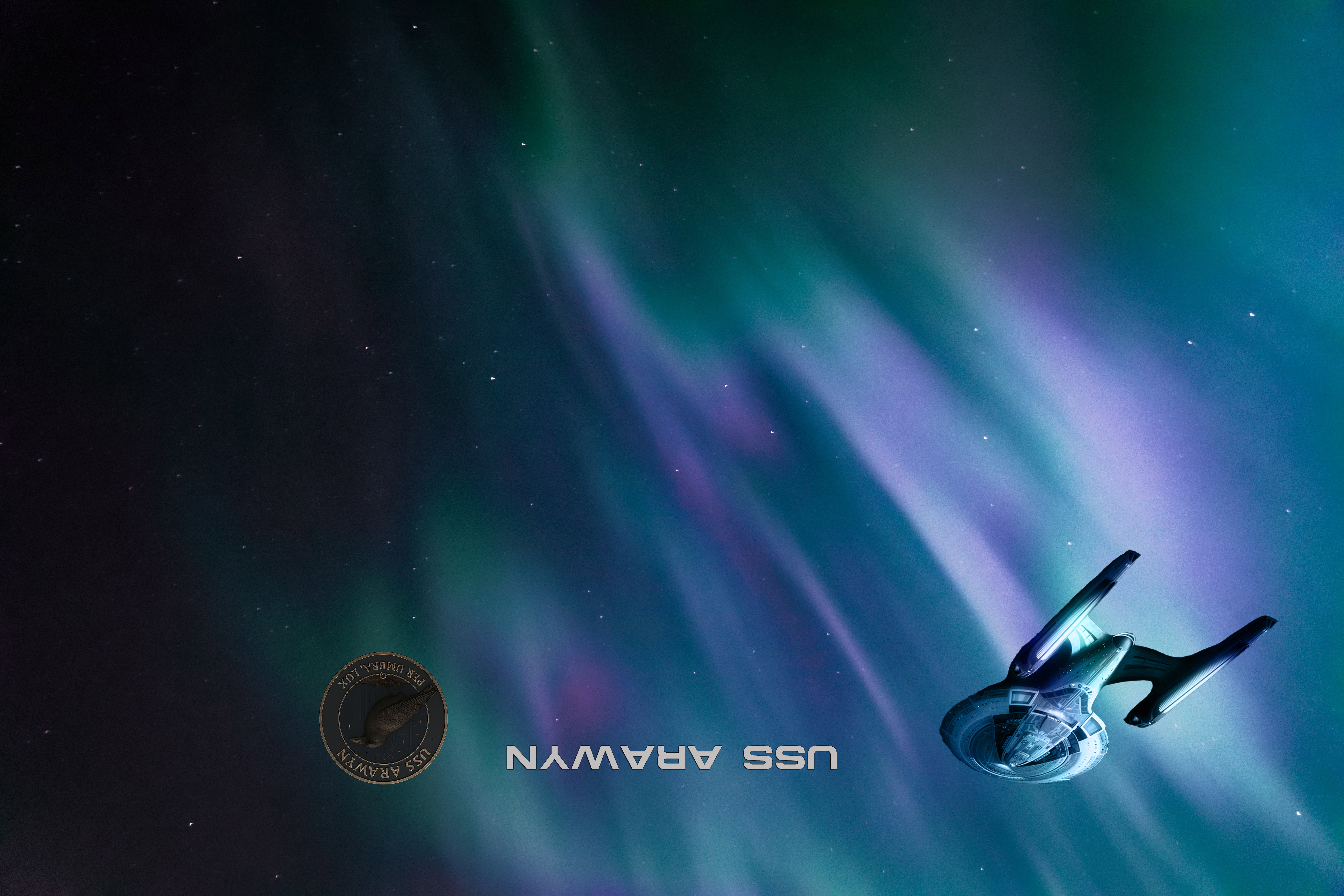


"Ghosts and Glass Jaws" Part 2
Posted on 14 Feb 2026 @ 2:54am by Lieutenant Commander Elias Harlan & Lieutenant Commander Grayson McKinney
2,630 words; about a 13 minute read
Mission:
Silent Inheritance
Location: Bridge and Main Engineering
0700 Hours | Bridge, USS Arawyn
The turbolift doors opened onto the bridge, and Grayson stepped out into his new command center for the first time.
The Arawyn's bridge was everything the recruitment holos promised: sleek, modern, bathed in the cool blue glow of LCARS interfaces. The captain's chair sat at the center, a throne of brushed duranium and leather. The viewscreen stretched across the forward bulkhead, displaying Lathira IV in crystalline detail. The air hummed with the low-frequency pulse of the bio-neural processors, a sound felt more than heard, vibrating through the deck plates.
It was beautiful.
It was also wrong.
Grayson's tactical console—his station, the place where he would spend the next however-many-years defending this ship—was dark. The primary targeting monitor was offline, the LCARS interface was dead, and a bright yellow sticky note, taped to the edge of the console, stood out like a wound against the clean lines of the bridge.
He crossed to the tactical arch in three long strides and pulled the note free.
Do not initialize. You'll fry the dorsal coupling. Come to Main Engineering. – Harlan
Grayson read it twice. Then he tapped the console to test it.
Nothing. Not even a flicker. The system was locked out at the hardware level, not just shut down but physically disconnected from the main power grid. Someone had crawled into the Jefferies tubes and pulled the relays by hand.
That someone was Chief Engineer Harlan.
Grayson folded the note and tucked it into his uniform pocket. Then he tapped his combadge.
"McKinney to Harlan."
A brief pause. Then a voice came through—male, clipped, with the faint edge of someone who'd been awake too long and was running on caffeine and spite.
"Harlan here."
"Commander, this is Lieutenant Commander McKinney. I'm standing on the bridge, staring at my tactical console, which appears dead. You left me a note."
"I did. You read it?"
"I did. Care to explain why my station is offline?"
There was a pause. Then, dryly: "Because the last time someone initialized the targeting grid, they nearly fried the dorsal phaser coupling. I'd rather not replace it before we leave orbit. If you want the long explanation, come to Main Engineering. If you want the short version: your tactical suite has issues the yard didn't fix. Bring coffee."
Grayson felt a grin tug at the corner of his mouth. "On my way, Commander."
He tapped his combadge again, cutting the channel, and turned toward the turbolift.
Behind him, the duty officer—a young ensign at ops—looked up nervously. "Sir, is everything all right?"
"Define 'all right,'" Grayson said, stepping into the turbolift. "Deck fifteen. Main Engineering."
The doors closed, and the turbolift hummed downward through the heart of the ship.
Grayson leaned against the railing, fingers drumming against his thigh—thrum-thrum-tap—and thought about the sticky note in his pocket.
Grayson had a feeling he and Commander Harlan would get along just fine.
Or they were going to drive each other insane.
Either way, it was going to be interesting.
The turbolift doors opened onto Deck 16, and Grayson stepped out into the corridor. The air here was warmer, carrying the faint tang of hot duranium, the smell of a ship's heart. Ahead, the massive doors to Main Engineering stood open, and beyond them, the warp core thrummed like a caged star.
He stepped through the doors into Main Engineering.
And found Chief Engineer Elias Harlan waiting for him.
Elias met Grayson's gaze across the central pool table, the warp core’s steady blue pulse casting long shadows between them. He held up the PADD—screen alive with scrolling status lines, red and amber alerts now far outnumbered by green progress bars—and tapped it once to freeze the latest snapshot.
“Commander McKinney,” he said, voice low but carrying easily in the near-empty bay. “This is the update as of 0600 this morning.”
He angled the PADD so McKinney could see the overview without leaning in too far—torpedo launcher diagnostics in bold green, phaser array still a patchwork of yellows and greens, power coupling statuses ticking upward.
“The torpedo launchers have passed their low-power test,” he continued. “Full cycle, no faults, no feedback spikes. We’re clear to arm them once the targeting grid is stable. The phaser array is still a work in progress. We had to rework the starboard and port power couplings—finished at 0300. Dorsal couplings are in progress right now; I’ve got forty people on them, another ten on the targeting system.”
He waved a hand through the mostly deserted main engineering compartment—only a handful of skeleton crew at monitoring stations, the rest scattered across the ship’s tactical grid.
“I’ve got everyone on a four-shift rotation. Normal engineering ops are down to a skeleton crew of six—bare minimum to keep the ship breathing. Everyone else is on the tactical array. And I apologize for the tactical console on the bridge still being dark. I locked it out at the hardware level. We’ve got unshielded EPS couplings popping up like bad welds—one of them sent one of my juniors through a vertical deck hatch on deck 17. He's fine, but now we aren't taking chances. Better safe than sorry. I’d rather the bridge glare at a dead screen than lose a console—or a crewman—to feedback.”
He set the PADD down on the pool table with a soft clack, then met McKinney’s eyes again—direct, no defensiveness, just the quiet certainty of a man who’d already decided the risk wasn’t worth taking.
“That’s where we stand. Launchers are good. Phasers are getting there. Targeting’s the bottleneck. Once we finish the dorsal rework and reload the operating software and start calibrating, I’ll clear the bridge console to come back online. After that, I highly recommend some range time for live-fire.”
Grayson studied the PADD in silence, his gaze moving over the progress bars with a quiet intensity. In that moment, the hum of Main Engineering faded into the background; he was alone with numbers and the weight of what they meant. The bars flickered, a wordless testament to effort and exhaustion, hope and frustration, green lines marching forward against the persistent yellows and reds. When he finally looked up, the wry half-smile that had carried him through a dozen close calls softened, giving way to something almost vulnerable, a glimpse of the man behind the uniform.
“Forty people on a four-shift rotation,” he said, voice low with a kind of reluctant admiration. “Skeleton crew on everything else. You pulled the entire department into the fire, and you’re still holding the line.”
He paused for a moment.
“You know, I came down here fully prepared to be the worst version of myself. The guy who hovers, second-guesses, and generally makes engineers contemplate the creative possibilities of decompressing an airlock just to get rid of me."
He tapped the PADD, the gesture more a salute than an accusation.
“But this? This is textbook crisis triage. You put your people first, locked down the hazards, and you’re rebuilding the tactical grid from the couplings up.”
He leaned against the pool table, arms crossing over his chest as if bracing himself against the gravity of the moment. The blue glow of the warp core painted shadows along his uniform, casting him as both participant and witness to the unfolding crisis.
“So here’s where I’m at. I want to help, not because you need a supervisor breathing down your neck, but because watching from the bridge while someone else resurrects my systems will slowly drive me insane. I’ve gotten my hands dirty fixing phaser arrays before, jury-rigged EPS taps on the fly, recalibrated targeting grids with nothing but a multimeter and a prayer. And more importantly…”
He gestured broadly, first to the warp core, the pulsing heart of the Arawyn, then back to Harlan, as if drawing a line between the ship’s survival and the engineer’s resolve.
“I know what it feels like to be the one holding the ship together when it’s all coming apart, feeling the burden with every pulse of the core. So if you’ve got a conduit that needs crawling, a coupling that needs tuning, or a calibration sequence that could use a second set of eyes, I’m here. And if you want an extra set of hands, my team is ready and willing to stand with yours until this ship is whole again. “
Grayson straightened, glancing at the pool table as if considering the map of repairs and progress spread out before them. He set his PADD down beside Harlan’s, a silent gesture of commitment; he was in, shoulder to shoulder.
“I want my entire department working alongside yours. We’ll help finish the job, and then, when everything’s green across the board, we’ll do a proper live-fire exercise, no shortcuts, no half-measures. We’ll put every repair through its paces and make sure these systems hold up under real pressure. That way, when it matters, we’ll know we can trust what we’ve built.”
Elias met Grayson’s gaze across the pool table, the warp core’s steady pulse lighting the space between them in cool blue. He gave a small, tired nod—respect, not warmth—then spoke.
“I appreciate that, Commander,” he said, voice low but carrying the quiet certainty of someone who’d been running on fumes for days. “I just got done doing a few years at Antares Fleet Yards, so I’ve got two hundred engineers total working on this—same scale I had back there.”
He tapped the pool table controls, and a holo-image of an EPS coupling shimmered into view—red highlights marking the unshielded sections, faint arcs of simulated energy dancing along the exposed lines.
“I won’t say no to more personnel,” he continued, “but they need to be briefed on the fact that what should be shielded EPS couplings are in fact unshielded. Tricorders set them off like a bad joke. I’ve got the industrial replicators running overtime to change them out, and so far, they only seem to pop up in the tactical array. So we’re replacing them—all of them.”
He tapped the console again, pulling up the master repair schedule—color-coded bars, shift assignments, progress percentages ticking upward. With a quick gesture, he sent a copy to Grayson’s database.
“Here’s what’s left,” Elias said. “It’s got the team schedules on it. Feel free to barge in on any of it. Obviously, you have a better idea of your people’s abilities and your tactical team’s strengths—I’ll reassign any engineering crews as necessary to keep the schedule moving.”
He leaned back slightly, rubbing the back of his neck once—a small, unconscious gesture of fatigue.
“I for one am grateful for the help,” he added, the words coming out quieter, almost reluctant. “I’ve been working three shifts myself since this started. Won’t mind having it done early.”
He gave Grayson a small, dry half-smile—nothing flashy, just the ghost of one.
“So yeah. Welcome to the party, Commander. Let’s get this array breathing again before it decides to stop breathing for all of us.”
He waited—calm, steady, ready for whatever came next. No defensiveness. No rush.
Just Elias Harlan, standing in his domain, offering a hand and a schedule to the man who’d just volunteered to share the load.
Grayson studied the repair schedule, his eyes moving between the active work sites and the flagged problem areas. After a moment, he looked up at Harlan.
"I can help with two things," he said. "Personnel and a technical problem you're stuck on."
He pulled up the holo-display and pointed to the amber-flagged entry. "This targeting grid calibration issue. The one throwing errors on the ventral emitters. You said you've replaced hardware twice, and it's still failing."
"Yes," Harlan said, frustration entering his voice. "I can't figure out what's wrong."
"It's not hardware. It's software." Grayson zoomed in on the error logs. "The targeting computer is running obsolete calibration protocols, but our sensors are the latest and greatest Starfleet-issued. The computer doesn't know how to read the higher precision data, so it flags everything as an error."
Harlan stared at the display, then at Grayson. "You're sure?"
"I've fixed this exact problem three times. On the Agincourt, the Ark Royal, and once on a ship I probably shouldn't have been modifying." Grayson straightened. "I can write you a patch that'll fix it. It'll take me about six or seven hours. Give me access to the tactical computer core, and I'll get it done."
Harlan pulled an isolinear chip from a nearby workstation and handed it over.
"Deck 8, Section 4. Workstation next to the computer core. It's quiet."
"Perfect." Grayson pocketed the chip, then pulled up the repair schedule again. "While I'm working on that, I'll deploy my people to your critical sites. I've got twelve officers with cross-training in engineering. Here's how I'll split them."
He highlighted three locations on the display. "Deck 12, dorsal couplings. That's your bottleneck. I'll send Lieutenant Vasquez with four people. She's worked on EPS systems before. She knows coupling architecture."
"That'll help," Harlan said, already updating his team assignments.
"Deck 9, port phaser array. Lieutenant Stavek, with four people. He’s good in tight spaces and handles heat better than humans. If your conduits are running hot, she's your best option."
Harlan nodded, adding the personnel to his schedule.
"Deck 17," Grayson continued. "Where Lieutenant Caldwell got hurt. I'll send Lieutenant Denari with three people. They'll help finish the safety retrofit on those unshielded couplings. I want that section locked down."
He met Harlan's gaze. "My people will follow your crew's lead. They're not there to take over. But they know how to work under pressure, and they'll pull their weight."
"Good." Harlan transferred the modified schedule to Grayson's PADD. "I'll brief my shift leaders. Your people will have full access to the tactical grid and emergency protocols."
"Appreciated." Grayson tucked the PADD under his arm. "I'll have everyone in position within the hour. We'll run comms checks, and I'll send progress reports every two hours. Once I finish the targeting patch, we can begin the install."
"Agreed." Harlan held out his hand. "Thank you, Commander. For the help. For not making this harder than it needs to be."
Grayson shook his hand firmly. "Thank you for trusting my people to work alongside yours. We'll get this done."
He turned towards the exit, then paused at the doorway. "And Commander? Get some sleep. You've been running this operation for three days. Allow us carry it for a shift."
Harlan hesitated, then nodded. "Six hours."
"Six hours," Grayson confirmed.
He stepped into the corridor and tapped his combadge. "McKinney to all tactical officers. Report to Briefing Room Two in fifteen minutes. We've got work to do."
The response came amid a chorus of acknowledgments.
Grayson headed for the turbolift, already planning the briefing in his head. Vasquez to Deck 12. Stavek to Deck 9. Denari to Deck 17. And himself to Deck 8, wrestling with targeting software until it behaved. He just hoped the grid would let itself be tamed this time, unless it had a few more surprises waiting for him.
He allowed himself a small smile as he headed for the turbolift. His people would handle the hardware. He'd handle the software. And between all of them, they'd get this ship breathing again.
Time to get to work.
End Log
Lt. Commander Grayson McKinney
Chief Tactical Officer
USS Arawyn
&
Lieutenant Commander Elias Harland
Chief Engineering Officer
USS Arawyn
 RSS Feed